L'Atelier
Engineering dossier for Le Pinson
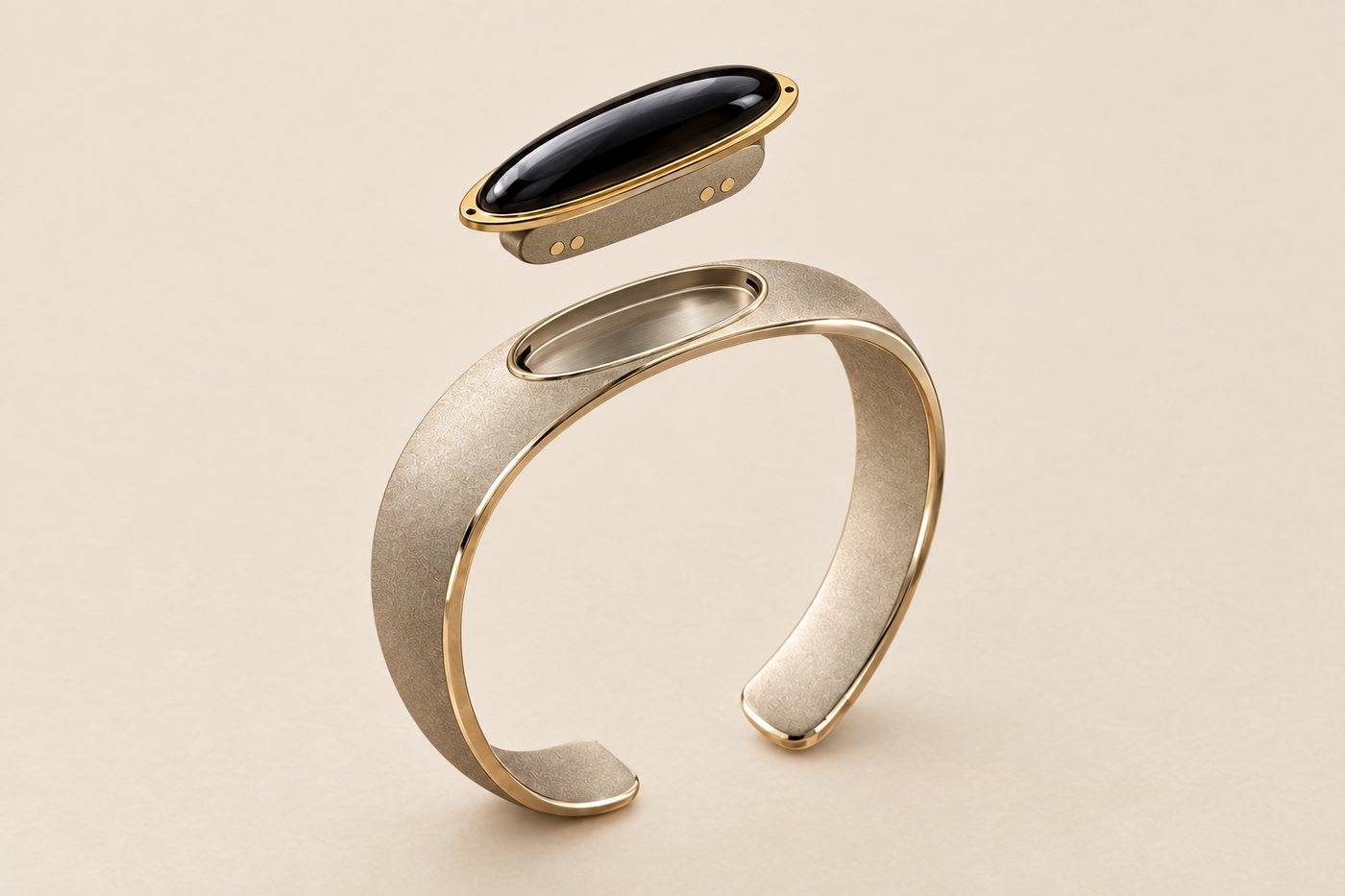
Le Pinson is a titanium cuff with a voice assistant. It is made of two parts: a solid titanium cuff that the owner keeps for life, and the stone itself: a sealed jewel module that holds all the electronics and lifts out of the cuff to be replaced every few years.
Research date 22 October 2026 · Prices in USD unless marked · Internal working document, not for publication.
In one minute
- Two parts. A permanent titanium cuff with no electronics, and a replaceable stone module (“Le Calibre”): the long black sapphire in its titanium bezel, with all the electronics in a small capsule hidden underneath.
- It looks like one jewel. The capsule sits in an oval cup machined into the top of the cuff; only the bezel and the stone show, 6.5 mm from skin to the top of the stone est.
- One module fits every cuff. All cuff sizes and finishes share the same oval cup. Owners can have several cuffs and one stone.
- Attachment: magnets seat the stone, a hidden spring latch locks it. To remove it, press a small pin through a hole on the skin side of the cuff, then lift the stone out.
- Battery, the honest number: the stone-only module holds a ≈ 25–30 mAh cell, about 3 days of typical use and 6 days of light use est. Option B extends the hidden body under the band to ≈ 48 mm for ≈ 50–60 mAh and about 6 days est. We prototype both.
- Size and weight: bezel 36 × 12 mm, stone 34 × 10 mm, capsule 35 × 11 × 4.0 mm; module ≈ 4.3 g, whole piece ≈ 23–25 g est.
- Business model: one titanium set at ≈ CHF 349, below the price of an Apple Watch. A new stone module every 3–4 years with a trade-in. Programme ≈ 20–26 months; funding ≈ CHF 5–7.5M to the first customer and ≈ CHF 12–18M over three rounds est (section 13).
What it looks like
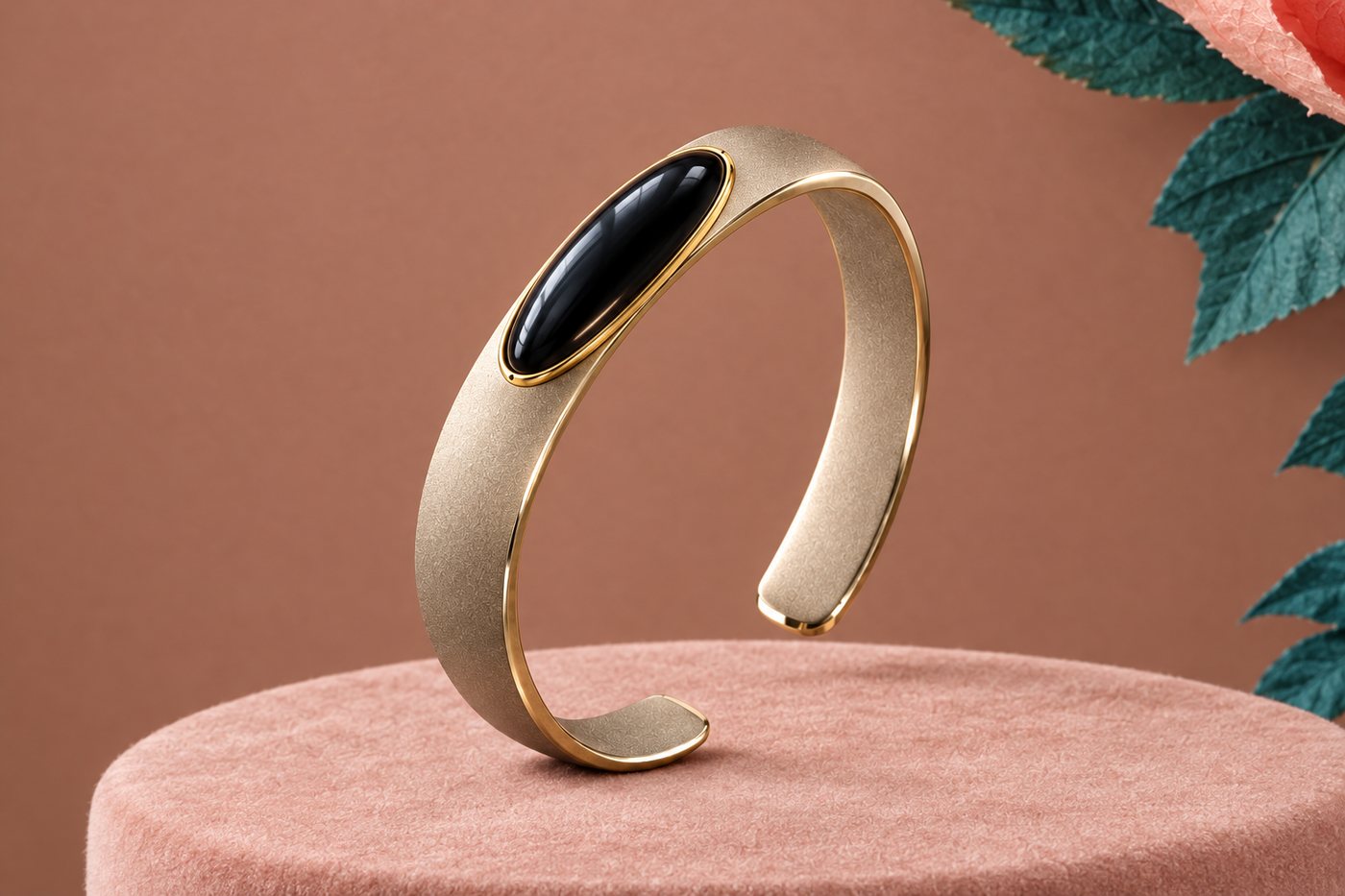
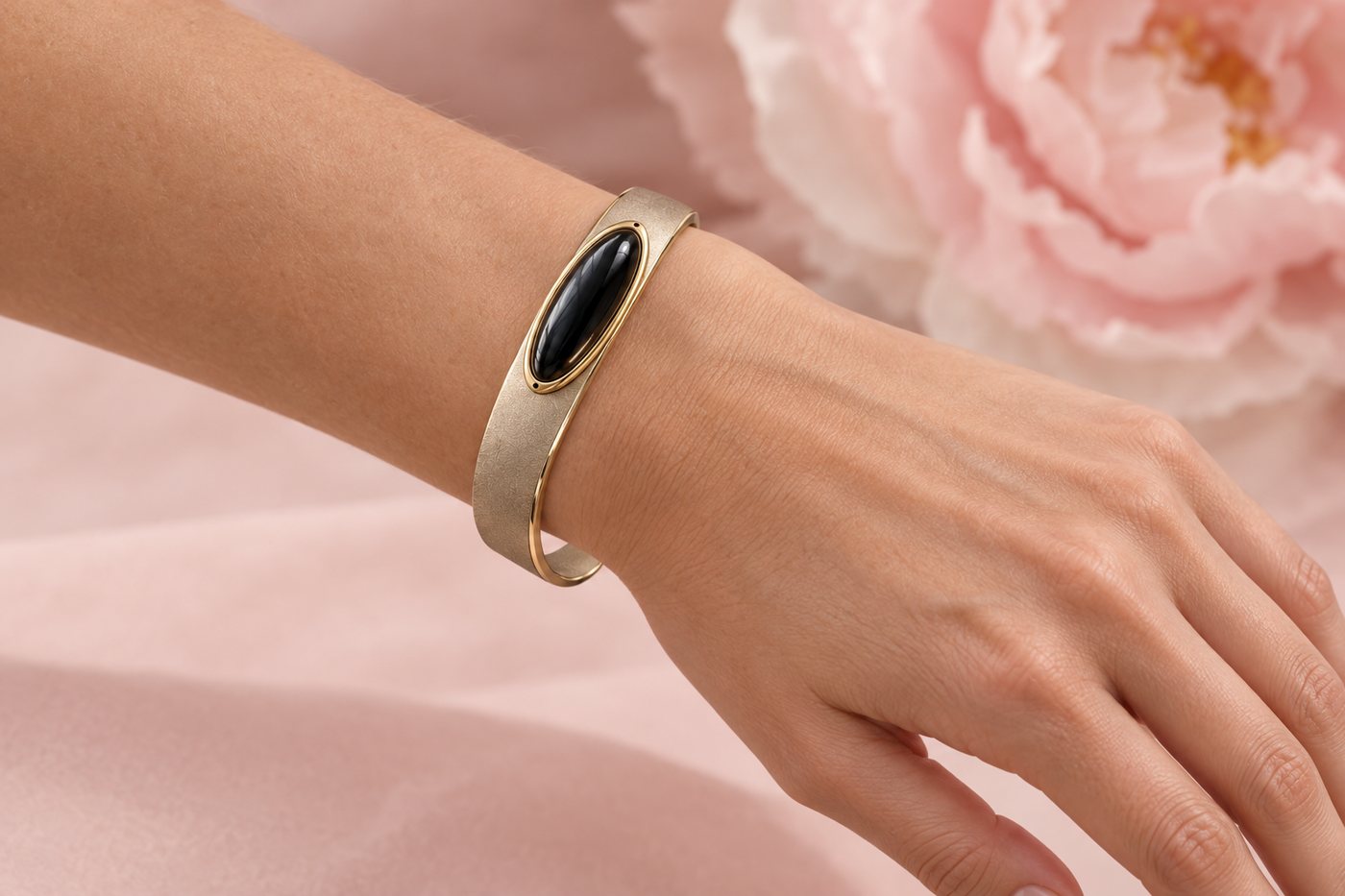
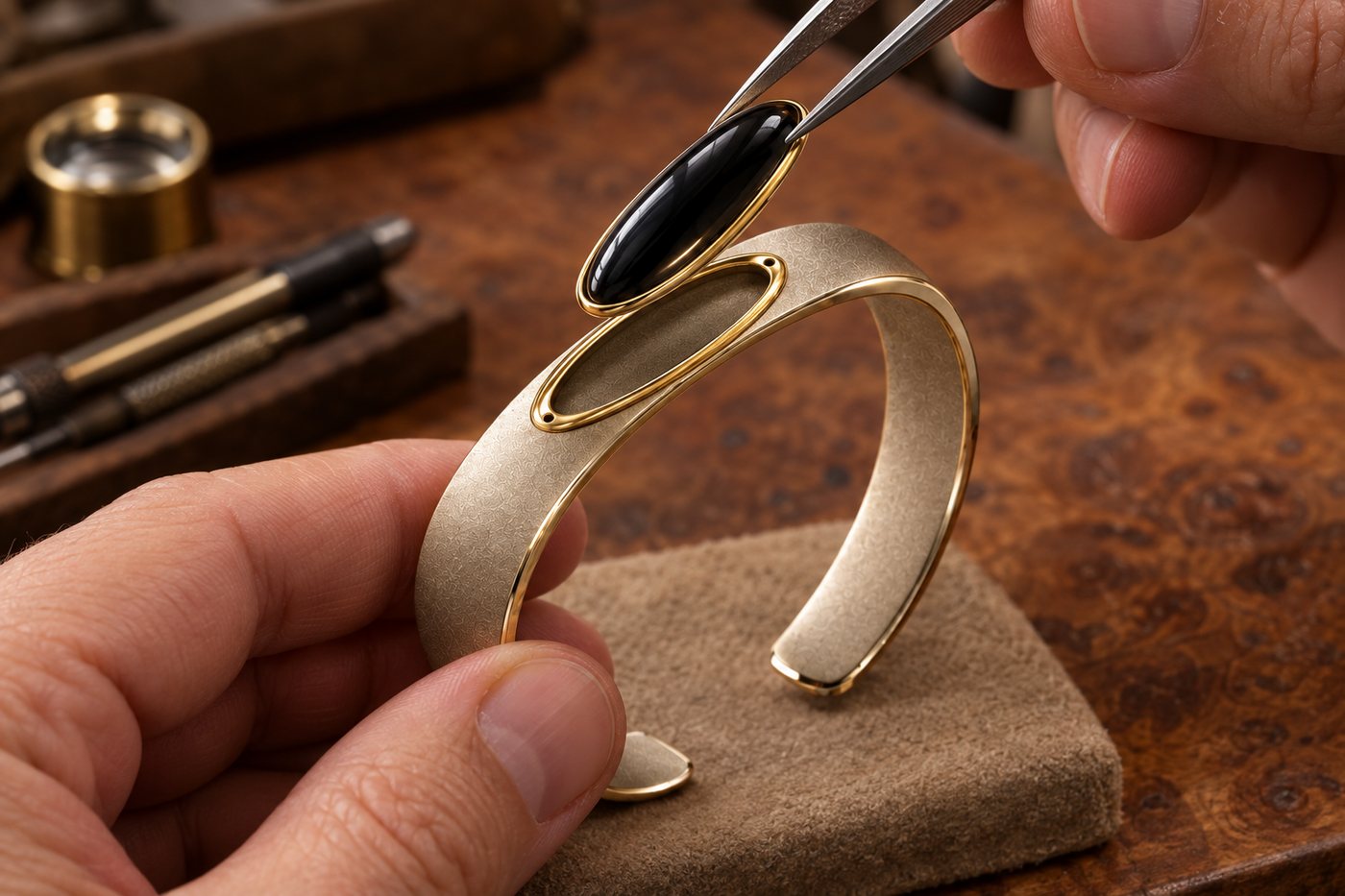
A slim titanium cuff with one long oval black stone in a gold-tone titanium rim. The stone is the module: all the electronics sit in a hidden capsule under it, and it lifts out of its seat to be charged, serviced or upgraded.
01The concept: permanent cuff, replaceable module
The jewellery and the electronics have different lifetimes, so they are separate objects. The cuff lasts decades; the module is upgraded every 3–4 years.
| Part | What it contains | Expected life | Service |
|---|---|---|---|
| Cuff | Solid Grade 23 titanium, sizes S–XL, with an oval cup machined into the top. No electronics, no battery, no seals. Natural titanium; black as a second finish later. | Decades | Refinishing service |
| Stone module (“Le Calibre”) | The titanium bezel and black sapphire you see, plus a hidden capsule with the chip and radio, 2 microphones, memory, power chip, accelerometer, battery, light, touch, click and charging pads. The bezel is the antenna. | 3–5 years of updates est | Battery replaced at the boutique; module exchanged for the next generation |
| Dock | Charging stand with spring-loaded contacts (pogo pins) and USB-C | Long | Works with every module generation if the pad layout is kept |
Why the stone is the module
- It keeps the look of the reference design: a slim cuff with one long stone, no box on top.
- The cuff can be finished and sold as jewellery, independent of the electronics.
- No wires or batteries bend when the cuff opens, so flex fatigue disappears.
- The antenna (the titanium bezel) sits above the titanium, not inside it, and is tuned once for all sizes.
- A small sealed capsule is easier to make waterproof than a whole cuff.
What it costs us
- Battery: the capsule only holds a ≈ 25–30 mAh cell, about 3 days of typical use est. Option B (longer hidden body) doubles that.
- The cuff must thicken to 5.0 mm around the cup, so it is heavier at the top (≈ 19–20 g) est.
- The latch must be excellent: secure, invisible and never released by accident.
- A small, valuable part that comes out of the cuff can be lost; the app and the exchange programme must cover that.
Business model in short
- One price for the set. Extra cuffs are inexpensive, so owners can have several and move the stone between them.
- The Maison exchange: every 3–4 years the owner returns the module and gets the new one at a reduced price. Returned modules are refurbished or recycled.
- Owners can buy more cuffs (another size or finish) and move one module between them.
- Rules to freeze in v1 so every future module fits every cuff ever sold: the oval cup dimensions, the hook undercut and latch notch positions, the release-pin hole, the steel insert positions and the pad layout on the capsule underside.
02Specification
One recommended configuration. Every part has a named second source, and every number that is not from a datasheet is marked.
| Cuff | Open rigid cuff in solid titanium Grade 23 (Ti-6Al-4V ELI, implant grade) V, 5-axis CNC from bar. 4 sizes S–XL, opening 35 / 37–38 / 39–40 / 41 mm. Band 10 mm wide and 2.4 mm thick in the arms, widening to 15 mm and thickening to 5.0 mm at the top est. |
| Cup | Oval cup ≈ 35.2 × 11.2 × 4.0 mm in the top of the cuff, 1.0 mm titanium floor, the same on every size: hook undercut at one end, latch notch at the other, a Ø1 mm release-pin hole through the floor, two ferritic steel inserts for the magnets est. |
| Stone module | Titanium bezel with gold-tone PVD ≈ 36 × 12 mm holding a smoked black sapphire cabochon ≈ 34 × 10 mm with a ≈ 1.5 mm dome. Hidden capsule ≈ 35 × 11 × 4.0 mm in titanium (zirconia as an option), 4 gold-plated charging pads underneath, IP68 est. |
| Height on the wrist | ≈ 6.5 mm from skin to the top of the stone: 1.0 mm floor + 4.0 mm capsule + 1.5 mm stone est. |
| Weight | Stone module ≈ 4.3 g, cuff ≈ 19–20 g, total ≈ 23–25 g for size M est. |
| Chip and radio | Nordic nRF54L15, 2.45 × 2.25 mm, Bluetooth Low Energy V. |
| Microphones | 2 × TDK T5838, 3.5 × 2.65 × 0.98 mm, wake-on-sound at 20 µA V; pinholes in the two bezel ends, ≈ 34 mm apart. |
| Memory | GigaDevice GD25LE128E, 128 Mbit: ≈ 2 h of offline audio plus an update slot. |
| Electronics | Rigid-flex: a main island ≈ 11 × 7 mm (chip, power chip, memory, crystals) and a light and sensor island under the stone, joined by flex; tall parts (microphones, accelerometer) at the capsule ends est. |
| Input | Touch on the stone (Azoteq IQS7222A), press on the stone (Qorvo FT-7600), taps (ST LIS2DUX12). |
| Feedback | Tiny LEDs under the stone; the stone clicks with a thin piezo bender (≈ 0.35 mm, custom, TDK PiezoHapt construction) driven by a Boréas BOS1901CW TC. No screen, no speaker. |
| Battery | One thin custom pill-shaped cell ≈ 29 × 7.6 × 2.0 mm, ≈ 25–30 mAh est. Prototypes: stock Grepow GRP1707026, 18.5 mAh, 25.8 × 6.5 × 1.7 mm V. |
| Battery life | Stone-only: ≈ 3 days typical when new, ≈ 2.5 days at end of life; ≈ 6 days in light use. Option B: ≈ 6 days typical est. |
| Charging | Stone out of the cuff, onto a dock with magnetic pogo pins (Mill-Max Maxnetic); full in ≈ 30–45 min est. |
| Audio to the wearer | Module → Bluetooth → phone app → assistant → the wearer's headphones, or the phone speaker. |
| Price | Set (cuff + stone module + dock) CHF 349, range CHF 299–399; module upgrade with trade-in CHF 129–149 est. |
Decisions where the options disagreed
| Topic | Decision | Why |
|---|---|---|
| Architecture | Permanent cuff + replaceable stone module. Rejected: electronics inside the crown; a cartridge inside the crown; a 34 × 15 × 7.4 mm block on top (looked like a gadget). | Keeps the reference look (one long stone flush in the band); separates jewellery life from electronics life. |
| Attachment | Magnets to seat, hook and hidden spring latch to lock, release pin from the skin side. | Nothing visible when worn; the release cannot be pressed while the cuff is on the wrist. Comparison in section 05. |
| Battery | One thin pill-shaped cell in the capsule (stock Grepow cells for prototypes, custom cell for production). Option B with a longer body as the fallback. | Only shape that fits a 35 × 11 × 4 mm oval; battery life is the main trade-off of the stone module. |
| Charging | Module on a dock with pogo pins. NFC wireless charging dropped. | Simplest and most efficient; no charger parts in the cuff; one less radio to certify. |
| Antenna | The titanium bezel, isolated on a zirconia ring; chip antenna under a ceramic capsule end as fallback. | The bezel sits above the titanium and is identical on every cuff, so it is tuned once. Simulate early. |
| Display | LED light glyph under the stone, not a screen. | Brightest through smoked sapphire, lowest power and cost. |
| Haptics | Thin piezo bender click (≈ 0.35 mm); no vibration motor. | The only actuator thin enough for a 4 mm capsule, and it makes the stone itself click. Needs a custom part. |
| Speaker | None in v1. | Space, battery and privacy. See section 09. |
| Capture | Gesture-first; always-listening is opt-in. | Battery, false triggers and recording law. |
03System architecture
The module captures speech and sends it to the phone. The phone and the cloud do the heavy work. Replies play in the wearer's headphones; the module answers with light and a click.
Swipe the drawing sideways →
04How everything fits
Everything sits in a 35 × 11 × 4.0 mm capsule under the stone. The height adds up with no margin, and the cell is half of it, so battery capacity is the price of the slim look.
4.0 General arrangement, to scale (size M)
All three views share one scale. The gold part is the removable stone module; the rest is the permanent cuff. Use the 10 mm scale bar to measure.
Swipe the drawing sideways →
4.1 Exploded view: stone module and cup
Swipe the drawing sideways →
- 1Smoked black sapphire cabochon, 34 × 10 mm, 1.5 mm dome
- 2Titanium bezel 36 × 12 mm (gold-tone PVD), isolated: the antenna; microphone pinholes in both ends
- 3Capsule, 35 × 11 × 4.0 mm, titanium, sealed IP68
- 4Pill-shaped cell under the board islands
- 5Hook tab that goes in first
- 6Spring latch tongue
- 7Four flush gold-plated pads for the dock
- 8Two magnets in the capsule base
- 9Solid titanium cuff: 5.0 mm at the cup, 2.4 mm in the arms
- 10Oval cup, 4.0 mm deep, 1.0 mm floor, ferritic steel inserts under the magnets
- 11Release-pin hole through the floor, on the skin side
4.2 Stone module seen from above
Swipe the drawing sideways →
- 1Cell, pill-shaped ≈ 29 × 7.6 mm, the largest shape that fits the oval
- 2Main island ≈ 11 × 7 mm: chip, power chip, memory, crystals
- 3Light and sensor island ≈ 10 × 6 mm: LEDs, touch, press, piezo driver
- 4Microphone A under the left pinhole
- 5Microphone B and accelerometer at the right end
- 6Two magnets in the base
4.3 Cross-section
Swipe the drawing sideways →
| Layer, from the skin | mm |
|---|---|
| Cuff floor (titanium) | 1.0 |
| Capsule base with magnets and pads | 0.4 |
| Cell | 2.0 |
| Swell gap + foam/shield | 0.25 |
| Board islands, 6-layer HDI | 0.35 |
| Top-side parts and thin piezo | 0.6 |
| Light and touch flex + air gap | 0.4 |
| Capsule (base to stone seat) | 4.0 |
| Stone above the band surface | 1.5 |
| Skin to top of the stone | ≈ 6.5 est |
The 4.0 mm stack has no spare height. If a part comes out thicker (a 2.2 mm cell, 0.8 mm inductors), the capsule goes to 4.3 mm and the cuff top to 5.3 mm; the look survives it.
4.4 On the wrist
Swipe the drawing sideways →
4.5 Option B: more battery under the band
Option B keeps the same stone and bezel, but the hidden body runs on under the band surface to ≈ 48 mm, so a longer curved cell fits.
| A · Stone only (design intent) | B · Extended body | |
|---|---|---|
| Hidden body | 35 × 11 × 4.0 mm, oval | ≈ 48 × 12 × 4.0 mm, curved along the band |
| Cell | ≈ 29 × 7.6 × 2.0 mm pill, ≈ 25–30 mAh est | ≈ 40 × 10 × 2.0 mm curved, ≈ 50–60 mAh est |
| Typical battery life | ≈ 3 days (≈ 2.5 at end of life) est | ≈ 6 days (≈ 5 at end of life) est |
| Looks | Only the stone shows; the cup is hidden by the bezel | A fine seam line runs ≈ 6 mm past each end of the bezel |
| Cuff | 5.0 mm thick over ≈ 40 mm | 5.0 mm thick over ≈ 52 mm; ≈ +2 g |
| Module mass | ≈ 4.3 g | ≈ 6 g |
Recommendation: build both in P1 (printed cuffs, real boards, stock Grepow cells) and decide after the one-week wear test. Stone-only is the design intent; Option B is the fallback if clients will not charge every two to three days.
4.6 Volume budget of the capsule
Inside the capsule: ≈ 34.2 × 10.2 mm oval × 3.2 mm ≈ 880 mm³ est.
| Part | Envelope (mm) | mm³ |
|---|---|---|
| Cell, pill-shaped | 29 × 7.6 × 2.0 | ≈ 415 |
| Cell swell allowance | 29 × 7.6 × 0.15 | ≈ 30 |
| Board islands | (11 × 7 + 10 × 6) × 0.35 | ≈ 50 |
| Top-side parts zone | (11 × 7 + 10 × 6) × 0.6 | ≈ 80 |
| Microphones and accelerometer at the ends | 2 × 3.5 × 2.65 × 0.98 + 2 × 2 × 0.74 | ≈ 25 |
| Light and touch flex | ≈ 20 × 6 × 0.3 | ≈ 35 |
| Thin piezo bender | ≈ 20 × 6 × 0.35 | ≈ 40 |
| Foam / shield | ≈ 220 mm² × 0.1 | ≈ 20 |
| Magnets, latch spring, hook | 2 × Ø3 × 1 + latch | ≈ 35 |
| Pads and wiring | 4 × Ø1.5 | ≈ 10 |
| Adhesive, vents, gaskets | — | ≈ 40 |
| Total | ≈ 780 (≈ 90 % of the volume) est |
Very tight: the oval ends and the curve make the last 10 % hard to use. Height, not volume, is the binding limit.
4.7 Weight budget, size M
| Item | Mass (g) |
|---|---|
| Stone module | |
| Titanium capsule, 0.4 mm walls | ≈ 1.2 |
| Titanium bezel, gold-tone PVD | ≈ 0.4 |
| Sapphire cabochon 34 × 10 mm | ≈ 1.1 |
| Cell | ≈ 0.7 |
| Boards, parts, light, piezo | ≈ 0.55 |
| Magnets, latch, pads, adhesives | ≈ 0.35 |
| Module subtotal | ≈ 4.3 |
| Cuff | |
| Top zone around the cup, 40 mm, 15 × 5.0 mm, minus the cup | ≈ 7.9 |
| Transitions, 2 × 15 mm | ≈ 5.6 |
| Arms, 60 mm, 10 × 2.4 mm | ≈ 6.4 |
| Cuff subtotal (≈ 19 g with 2.2 mm arms) | ≈ 19–20 |
| Total, size M | ≈ 23–25 est |
Within the 22–26 g target. Most of the cuff weight is the thick zone around the cup; a shorter transition or a lighter top zone with internal pockets saves 1–2 g.
4.8 Strength of the cuff
- No flex fatigue: no wires, flex circuits or cells run through the band, so nothing electronic bends when the cuff opens.
- Opening the cuff loads the titanium arms. For 2.4 mm arms (E = 114 GPa, R = 26 mm), stress is ≈ 345 MPa at an 8 mm opening and ≈ 430 MPa at 10 mm, close to the ≈ 470–500 MPa fatigue limit of Grade 23 est. Limit the service opening to 8 mm, or thin the arms to 2.2 mm. FEA and a 10,000-cycle coupon test remain mandatory.
- The cup zone is 5.0 mm thick and does not bend, so the latch and the stone never see the opening load.
05Attachment
Recommended: magnets seat the stone, a hook and a hidden spring latch lock it, and a pin pressed through a hole on the skin side releases it. Nothing shows when worn, and it cannot be released while the cuff is on the wrist.
| Option | How it works | Security | Feel and looks | Verdict |
|---|---|---|---|---|
| Magnets + hook + spring latch, skin-side release | Hook end in first, then the stone drops in; magnets pull it home and the latch clicks. To remove: take the cuff off, press the pin through the hole on the inner face, lift the stone. | High: the release hole is against the skin when worn | A soft magnetic pull and a click; nothing visible | Recommended |
| Magnets only | Strong magnets hold the stone in the cup. | Medium: can be knocked out | Very easy; risky for a precious part | Rejected |
| Bayonet quarter-turn | Turn the stone into lugs, like a watch caseback. | High | An oval stone cannot turn inside an oval cup | Rejected |
| Screw-down | Two screws from the skin side. | Very high | Needs a tool every time the owner charges | Rejected (boutique-locked option only) |
Design rules
- One standard oval cup on every cuff size and finish; checked with a master gauge stone at the end of the line.
- Magnets (NdFeB, coated) sit sealed inside the capsule base; the cuff has small ferritic stainless steel inserts in the cup floor (no nickel against the skin).
- Latch spring and tongue sit in a blind pocket outside the sealed electronics volume. Release pin travel ≥ 0.6 mm; the dock carries a small tool for owners with short nails.
- Materials: titanium or 316L latch parts, hardened faces, no plating that can flake TC.
Test requirements
| Test | Requirement |
|---|---|
| Pull-off, straight up, latch engaged | ≥ 80 N without release est |
| Side push on the stone | ≥ 50 N without release or movement est |
| Release pin | 4–8 N, ≥ 0.6 mm travel; the stone only lifts when the pin is pressed est |
| Magnet seating | Pulls the stone home from ≥ 1 mm; ≤ 2 N to lift once released est |
| Cycle life | 5,000 remove and refit cycles (≈ 3 a day for 4 years), retention still ≥ 80 % est |
| Drop | 1.5 m onto hard floor, 26 drops in all orientations: the stone stays in and works est |
| Sweat and corrosion | 7-day artificial sweat soak and 96 h neutral salt spray (ISO 9227) on latch, hook, inserts and pads: no corrosion, no sticking est |
| Rattle | Free play ≤ 0.05 mm; no audible rattle est |
06Bill of materials
Module electronics cost ≈ $61 per unit at 1,000 and ≈ $33 at 10,000 est. Board making and assembly are the biggest lines, not the chips.
| Group | @1k | @10k |
|---|---|---|
| Core silicon: chip, 2 microphones, memory, power chip, accelerometer, crystals | $11.43 | $9.06 |
| Stone interface: touch, press, piezo click, LEDs | $9.60 | $4.40 |
| Antenna, passives, protection | $0.95 | $0.60 |
| Power: cell, protection, pads | $6.80 | $4.40 |
| Mechanics in the module: latch, magnets, acoustic vents | $5.50 | $3.00 |
| Board and assembly | $27.00 | $12.00 |
| Module electronics | ≈ $61 | ≈ $33 |
Full bill of materials 23 lines with part numbers and second sources
| # | Part | Function | Size (mm) | Qty | Buy at | @1k | @10k | Second source |
|---|---|---|---|---|---|---|---|---|
| Core silicon | ||||||||
| 1 | Nordic nRF54L15-CAAA-R7 | Bluetooth chip, codec, crypto | 2.45 × 2.25 × 0.42 | 1 | DigiKey, Future, Farnell | 2.90 | 2.00 | nRF54LM20A; nRF5340 |
| 2 | TDK MMICT5838-00-012 | Microphone with wake-on-sound | 3.5 × 2.65 × 0.98 | 2 | Avnet, DigiKey, Farnell | 2.50 | 2.22 | Knowles SPH0641LU4H-1; Infineon IM69D128S |
| 3 | GigaDevice GD25LE128E | 128 Mbit memory: audio + updates | 3 × 3 × ≤ 0.6 | 1 | LCSC, Braemac | 1.75 | 1.30 | Winbond W25N01GW |
| 4 | Nordic nPM1304-CAAA-R7 | Power chip, charger, fuel gauge | 3.1 × 2.4 | 1 | DigiKey, Future | 1.56 | 1.38 | nPM1300; TI BQ25120A TC |
| 5 | ST LIS2DUX12TR | Accelerometer with tap detection | 2.0 × 2.0 × 0.74 | 1 | ST, RS | 1.50 | 1.20 est | Bosch BMA530 / BMA580 |
| 6 | ECS-320-CDX-2374 | 32 MHz crystal | 1.2 × 1.0 | 1 | DigiKey | 0.72 | 0.61 | Murata / TXC / Epson TC |
| 7 | Epson FC-12M | 32.768 kHz crystal | 2.05 × 1.2 | 1 | RS | 0.50 | 0.35 | Epson FC-12D |
| Stone interface | ||||||||
| 8 | Azoteq IQS7222A | Touch through the stone | 1.62 × 1.62 | 1 | DigiKey, Mouser | 0.60 est | 0.40 | Infineon PSOC 4000T; Microchip CAP1203 |
| 9 | Qorvo FT-7600 | Press on the stone | 0.8 × 1.2 × 0.22 | 1 | Qorvo (quote) | 1.00 est | 0.50 est | Qorvo FT-4100; TI LDC2114 |
| 10 | Thin piezo bender, custom (TDK PiezoHapt construction) | Piezo: the stone clicks | ≈ 20 × 6 × 0.35 | 1 | TDK (custom quote) TC | 3.00 est | 1.50 est | PI Ceramic custom bender |
| 11 | Boréas BOS1901CW | Piezo driver | 2.1 × 2.2 | 1 | Mouser | 2.00 est | 1.00 est | Boréas BOS1931 |
| 12 | ROHM SML-P12 / LITEON LTW-FC03DCD5 + driver | LED glyph (10–30 LEDs) | 1.0 × 0.6 × 0.2 | set | DigiKey, Mouser | 3.00 est | 1.00 est | Vishay 0201 LEDs |
| Antenna, passives, protection | ||||||||
| 13 | Bezel feed + matching, or Antenova Weii SRCW004 | Antenna | 0201 / 1.0 × 0.5 | 1 | Murata, Johanson, Antenova | 0.40 est | 0.25 est | Johanson 2450AT18A100 |
| 14 | Passives, ≈ 40 | Decoupling, inductors | 01005 / 0201 | set | LCSC, DigiKey | 0.40 est | 0.25 est | — |
| 15 | TVS diodes | ESD on pads and ports | 0201 | 4 | Nexperia, TI | 0.15 est | 0.10 est | — |
| Power | ||||||||
| 16 | Custom pill-shaped LiPo cell (prototypes: Grepow GRP1707026, 18.5 mAh V) | LiPo cell, ≈ 25–30 mAh est | ≈ 29 × 7.6 × 2.0 | 1 | Grepow | 2.50 est | 1.60 est | EEMB or Jauch custom |
| 17 | Protection IC (TI BQ2970 / ABLIC S-82) + NTC + cell flex | Cell protection, service connector | on cell | 1 | Cell maker | 2.50 est | 1.80 est | Jauch |
| 18 | Bulk capacitors | Peak buffer | low profile | set | Murata, TDK | 0.30 est | 0.20 est | — |
| 19 | 4 gold-plated charging pads in ceramic inserts | Dock contacts | Ø1.5 | 4 | Case maker TC | 1.50 est | 0.80 est | — |
| Mechanics in the module | ||||||||
| 20 | Latch tongue and spring, hook, 2 NdFeB magnets | Attachment | magnets Ø3 × 1 | set | Case maker TC | 4.50 est | 2.30 est | — |
| 21 | W. L. Gore GAW337 / GAW338 | Waterproof acoustic vents | Ø ≈ 2–3 | 2 | Gore | 1.00 est | 0.70 est | Nitto Denko TC |
| Board and assembly | ||||||||
| 22 | Rigid-flex: two 6-layer HDI islands joined by flex | Boards | 11 × 7 and 10 × 6 | 1 | Dyconex (CH) | 12.00 est | 6.00 est | Cicor; Würth; AT&S |
| 23 | Assembly, underfill, test | PCBA | — | 1 | Cicor, Boudry (CH) | 15.00 est | 6.00 est | Shenzhen EMS |
| Total module electronics | ≈ $61.28 | ≈ $33.46 | est | |||||
Changed against the block module: a smaller pill-shaped cell, a custom thin piezo instead of the 1.4 mm PowerHap, two board islands on rigid-flex, magnets added, the dovetail rail removed. The dock is costed separately in section 12.
Enclosure parts per unit
| Line | @1,000 | @5,000 | @20,000 |
|---|---|---|---|
| Cuff | |||
| Solid titanium cuff, CNC, brushed and bead-blasted | $25–45 | $14–26 | $10–18 |
| Oval cup, hook undercut, latch notch, release hole, steel inserts | $6–12 | $3–6 | $2–4 |
| Module housing | |||
| Titanium capsule and base, CNC | $10–18 | $6–12 | $4–8 |
| Sapphire cabochon 34 × 10 mm, smoked coating | $10–20 | $6–12 | $4–8 |
| Titanium bezel, gold-tone PVD, zirconia insulator | $5–10 | $3–6 | $2–4 |
| Sealing (bonding, base O-ring), leak test | $3–6 | $2–4 | $1.5–3 |
| Tooling and fixtures (4 cuff sizes, 1 module, stone, coating, 2 RF loops) | $40–90k once | ||
Titanium only, no precious metals. Prototypes are machined in Switzerland; production parts come from an Asian titanium case maker that already makes watch cases (for example Boze Titanium, section 11). All figures are estimates until we have three quotes TC.
07Cuff, module housing and stone
The cuff and the module housing are machined titanium, made the same way as a watch case. Prototypes in Switzerland, production with an Asian titanium case maker.
Materials and finishes
| Element | Specification | Suppliers |
|---|---|---|
| Cuff | Ti-6Al-4V ELI Grade 23 bar with EN 10204 3.1 certificates; no nickel. 5-axis CNC from bar, hand polish or satin brush, bevelled edges. Forged blanks above 5k units. | Bar: Harald Pihl (SE), Bibus Metals (CZ/CH). CNC: MRP SA (Alle), Queloz SA (Saignelégier), Simon Et Membrez (Delémont); Boze (CN) |
| Outer finish | Brushed and bead-blasted natural titanium, with no coating to wear off. Black DLC as a second finish later. | Case maker; DLC by the case maker or Oerlikon Balzers (LI) TC |
| Inner face | Raw polished Grade 23 against the skin. No liners. | — |
| Module capsule | Grade 23 titanium (zirconia ceramic as an option), 0.4 mm walls, hidden in the cup; base held by two M1.0 screws and an O-ring so the battery can be serviced. | Same case makers TC |
| Bezel | Thin oval bezel 36 × 12 mm in titanium with gold-tone PVD. Isolated from the capsule on a zirconia ring because it is the antenna. | Case maker; PVD by the coater TC |
The stone
- Synthetic sapphire cabochon ≈ 34 × 10 mm with a ≈ 1.5 mm dome and a flat polished back.
- Smoked black look: clear sapphire with a dark coating on the back (10–30 % light through a small window for the LEDs, ≤ 5 % elsewhere). Opaque black sapphire cannot pass light and is only for a no-light edition.
- The dome bends the light, so the LED window is tested on real cabochons, not flat samples TC.
- Anti-reflection coating on the inner face only, because an outer coat scratches.
- Suppliers: Stettler Sapphire (Lyss) first, Saphirwerk (Brügg) second, Sun Yin Crystal (Hong Kong) for the China route.
Antenna
- Titanium blocks radio, so a metal part has to become the antenna. Primary: the titanium bezel around the stone, isolated on a thin zirconia ring and fed through a spring contact inside the capsule.
- The bezel stands above the titanium band and is identical on every cuff, so it is tuned once on a master cuff instead of once per size.
- It sits only ≈ 1 mm above the titanium surface, which still detunes it; simulate (CST or HFSS) with a wrist model before cutting metal and budget two tuning loops.
- Fallback: a chip antenna (Antenova Weii) under a zirconia end of the capsule. Partners: Ignion, Taoglas, Antenova, CSEM.
Sealing (module only)
| Joint | Method |
|---|---|
| Stone to bezel, bezel to shell | Light-curing sealing adhesive (DELO PHOTOBOND class) plus a structural fillet |
| Base to capsule | 2 M1.0 screws and an FKM O-ring, like a small watch caseback; opened only at the Maison |
| Microphone ports | Pinholes in the two bezel ends → channel into the capsule → Gore GAW337/338 membrane (IP68) → gasket → microphone; 1–3 dB loss expected est |
| Charging pads | Gold-plated pads bonded in ceramic inserts, flush with the base |
| Latch and magnets | Latch outside the sealed volume in a blind pocket; magnets sealed inside the base |
Tests: IP68 at 1.5 m for 30 min (IEC 60529) and 3 ATM (ISO 22810). Skin contact: EN 12472 wear then EN 1811 nickel release on the cuff and the module base; ISO 10993-5/-10 on finished coated parts.
08Battery and charging
The stone-only capsule fits a ≈ 25–30 mAh cell: about 3 days of typical use, 6 days of light use. Option B doubles it. The stone charges on a dock in 30–45 minutes while the cuff stays on the wrist as jewellery.
Cell candidates
| Cell | Size (mm) | Capacity | Fit |
|---|---|---|---|
| Custom pill-shaped cell (Grepow) | ≈ 29 × 7.6 × 2.0 | ≈ 25–30 mAh est | Production cell for the stone-only module |
| Grepow GRP1707026 V | 1.7 × 6.5 × 25.8 | 18.5 mAh | Stock prototype cell for option A (≈ 2 days typical) |
| Grepow GRP1607027 V | 1.6 × 6.5 × 26.5 | 17 mAh | Second stock prototype cell |
| Custom curved cell, Option B (Grepow) | ≈ 40 × 10 × 2.0, bend radius ≈ 30 | ≈ 50–60 mAh est | Production cell for Option B (Grepow lists a 28.5 mm minimum bend radius TC) |
| Grepow GRP2508030 V | 2.55 × 8.1 × 29.2, curved | 40 mAh | Stock prototype cell for Option B in a 4.6 mm body |
| EEMB LP301230 V | 3.5 × 12.5 × 31 | 70 mAh | Too thick for the stone module (was the block-module cell) |
Grepow figures from the Grepow curved-battery catalogue. Custom capacities scaled from those cells at ≈ 0.065–0.075 mAh per mm³ est; confirm with Grepow, with UN38.3 reports, discharge rate and minimum order TC.
Power draw (from the earlier power study, unchanged electronics)
| Mode | Average current | Charge |
|---|---|---|
| Idle: tap wake armed, Bluetooth kept alive | ≈ 40–55 µA | ≈ 1.2 mAh/day |
| Listening-mode standby (one microphone on wake-on-sound) | ≈ 45–55 µA | ≈ 1.3 mAh/day |
| Recording to memory | ≈ 2.5–3.5 mA | ≈ 3 mAh/h |
| Live streaming to the phone | ≈ 3.5–5 mA | ≈ 4.5 mAh/h |
| Light glance (5 s) | ≈ 4–5 mA | ≈ 6 µAh |
Battery life
| Use | mAh/day | A · stone only, new / end of life | B · extended, new / end of life |
|---|---|---|---|
| Light: 20 min capture, 40 glances | ≈ 3.8 | ≈ 6.3 / 5 d | ≈ 13 / 10.5 d |
| Typical: 1 h capture, 100 glances | ≈ 8 | ≈ 3 / 2.4 d | ≈ 6.2 / 5 d |
| Listening mode, light (2 h speech) | ≈ 6.7 | ≈ 3.6 / 2.8 d | ≈ 7.5 / 6 d |
| Listening mode, typical (4 h speech) | ≈ 11.7 | ≈ 2 / 1.6 d | ≈ 4.3 / 3.4 d |
| Heavy (noisy office, TV) | ≈ 19–22 | ≈ 1 d | ≈ 2.5 d |
Usable ≈ 24 mAh new and ≈ 19 mAh at end of life for A; ≈ 50 and ≈ 40 mAh for B est. Honest customer claim for A: “two to three days; about a week in light use”. Ways to stretch it: gesture-first capture, a longer idle Bluetooth interval, and a travel écrin that tops the stone up. Confirm with a power profiler on the development kit.
Dock
- Desk stand and travel écrin with magnetic pogo pins (Mill-Max Maxnetic) and USB-C. The stone drops onto it; magnets align it. The écrin can carry its own cell to top the stone up on the move.
- Pads are live only on the dock, with reverse and ESD protection; charge at 0–45 °C; full in ≈ 30–45 min est.
- Optional: a second module so the owner never waits; or wear the cuff alone while charging.
EU Battery Regulation
Article 11 applies from 18 February 2027; a delegated act adopted on 14 July 2026 lets wearables keep a battery that only an independent professional replaces V. Our answer: a screwed module base, a connectorised cell, published instructions, spare cells for ≥ 5 years and a boutique battery service. Cells need UN38.3 and IEC 62133-2.
09Stone interface, firmware, app and audio
The stone is the whole interface: it lights, senses touch and press, and clicks. Spoken replies come through the phone, not from the module.
The stone
- Light: a line, a pulse, three to five icons and a recording dot, made of tiny LEDs behind the dark coating.
- Touch: a transparent electrode on the back of the stone; two electrodes allow a swipe.
- Press: a force sensor under the stone seat.
- Click: the piezo moves the stone ≈ 15 µm in under 1 ms, like a laptop trackpad.
| Gesture | Action |
|---|---|
| Press and hold the stone | Talk to the assistant |
| Double tap on the cuff | Start or stop recording, confirmed by a click and a line of light |
| Triple tap | Privacy mute |
| Swipe across the stone | Optional |
Firmware
| Layer | Choice |
|---|---|
| RTOS / SDK | nRF Connect SDK 3.x (Zephyr) |
| Secure boot and updates | MCUboot with Ed25519 signatures, keys in the nRF54L KMU (provision on first flash); SMP over BLE; secondary slot on the external NOR (≈ 1.5 MB, rest for audio); anti-rollback; staged rollout 1 % → 10 % → 100 % |
| Audio front end | PDM at 16 kHz → high-pass → optional fixed delay-and-sum of two mics → AGC; 200–300 ms ring buffer to cover the 50–150 ms wake latency |
| Codec | Opus (CELT low complexity, ≈ 14–20 % CPU on M33 est) or LC3 via Google liblc3 (Apache-2.0); decided by benchmark |
| Transport | Custom GATT service (Omi-style): audio notify, codec ID, control point; sequence + timestamp header; 2M PHY, 2–3 frames per connection event. ≈ 1.3 Mbps measured on 2M PHY vs 16–32 kbps needed: radio-on time, not throughput, is the constraint. |
| Offline | Encrypted (AES-256-GCM, KMU key) store-and-forward on NOR, wiped after phone acknowledgement |
| Our own modules | Trigger manager, speech check, light and click grammar, factory test mode, crash dumps |
Audio path to the headphones
The Bluetooth chip in the module cannot stream audio to AirPods, and iPhones do not support LE Audio. The path is therefore: module → Bluetooth → phone app → speech-to-text → assistant → speech synthesis → headphones. Because the microphone is in the module, the phone never opens its own microphone and the headphones keep full sound quality. Expected delay ≈ 0.8–1.4 s est. Without headphones: phone speaker, a notification, or a click and a line of light.
Built-in speaker: not in v1
| Factor | Speaker in the module | Headphones or phone (v1) |
|---|---|---|
| Space | Needs its own air volume and an opening; the module is already ≈ 90 % full | No cost |
| Power | ≈ 100–300 mW while playing est; battery would drop to a few days | Phone and headphones pay |
| Sound | Thin and quiet at wrist distance | Full quality |
| Privacy | Everyone nearby hears the reply | Private |
| Water and looks | Another hole and membrane; a visible grille | Only the microphone ports |
Voice recorders and pendants (Plaud, Bee, Limitless) also have no speaker. Because the module is replaceable, a speaker can be added in a later module generation if users ask for it, with no change to the cuff.
Phone and cloud
- iOS (top software risk): pair with AccessorySetupKit from day one; the “phone locked, music playing, press, hear the answer” test is a week-3 go/no-go.
- Android: CompanionDeviceService, with a foreground service as fallback.
- Apple MFi: not required for Bluetooth Low Energy accessories.
| Line (per user per month) | Lean stack | Premium stack |
|---|---|---|
| Speech-to-text (120 min) | Soniox $0.24, or Apple on-device $0 | Deepgram Nova-3 multilingual $0.70 |
| Assistant (900 turns, ≈ 3K in / 300 out) | Claude Haiku 5.5 ≈ $0.41 | Claude Sonnet 5.5 ≈ $8.10 (≈ $4 with caching) |
| Speech synthesis (900 replies) | Apple on-device $0, or Gemini Flash-Lite TTS ≈ $2.2 | ElevenLabs Flash ≈ $7.20 (signature Maison voice) |
| Infrastructure | ≈ $0.3–0.5 | ≈ $0.5–1 |
| Total | ≈ $1–3 | ≈ $12–17 |
Simple requests (timer, note, reminder) run on the phone; harder ones go to the cloud. Budget ≤ CHF 1 per user per month est; keep vendors swappable because model prices change.
Privacy and the law
Hidden jewellery and recording law pull in opposite directions. Swiss criminal code Art. 179ter forbids recording a private conversation without consent; Germany has §201 StGB; about a dozen US states require everyone's consent.
- Default: the wearer starts every recording; no rolling buffer of other people's speech. Listening mode is opt-in, time-limited, and stops off the wrist.
- Notice: during capture the stone shows a faint glow line and the wearer feels a click.
- Security: encrypted Bluetooth pairing, encrypted audio frames and memory, TLS 1.3, audio deleted within 24 h by default (proposal).
- Losing a module: data on it is encrypted and the app can block it; the owner's history lives in the account, so a replacement module restores it.
- Compliance: GDPR impact assessment, Swiss nFADP, EU AI Act Art. 50 transparency, Cyber Resilience Act, RED EN 18031. Counsel sign-off before the design is frozen.
10Make, customise or buy
Buy the chips; have suppliers make our designs (cuff, module housing, stone, board, cell); do firmware, app, design, final assembly and quality in-house.
Buy catalogue part · Custom our design, made by a supplier · Make in-house
| Subsystem | Decision | Who | Why |
|---|---|---|---|
| Chip, power chip, microphones, memory, sensors | Buy | Nordic, TDK, GigaDevice, ST | Standard parts; a ready radio module (Raytac AN54L) can be used in early prototypes |
| Touch, press, piezo, LEDs | Buy chips, Custom layout | Azoteq, Qorvo, TDK, Boréas, ROHM | The stone mechanics are our know-how |
| Cell | Buy now, Custom later | Grepow stock cells; Grepow custom pill and curved cells | Stock cells to start fast; custom cells to fill the oval capsule |
| Antenna | Custom | Bezel design with Ignion or Taoglas | Top radio risk |
| Board and assembly | Custom | Dyconex, Cicor (CH) or PCBWay/JLCPCB for prototypes; Asian EMS for production | Cost at volume |
| Cuff (all sizes) | Custom | Swiss CNC (MRP, Queloz) for prototypes; Asian titanium case maker for production | Our design, their machines |
| Capsule, bezel, latch and magnets | Custom | Same case makers TC | Watch-head-type part |
| Stone and smoked coating | Custom | Stettler Sapphire; Saphirwerk | Tint must be qualified |
| PVD finish | Custom | Positive Coating; Oerlikon Balzers | Specialist process |
| Dock and écrin | Custom | Mill-Max pogo pins; EMS for the board | A branded daily ritual |
| Firmware, app, cloud | Make | In-house; Nordic partners (GoodByte, Elimo, Zühlke) for support | Core know-how |
| Jewellery design | Make | In-house designer + Creaholic or Helbling for manufacturability | The Maison owns the look |
| Final assembly, sealing, test | Buy | EMS in Asia; quality sign-off in Geneva | Keeps the price at CHF 349 |
| Certification | Buy service | Montena, TÜV SÜD, Eurofins, SGS TC | Mandatory third-party testing |
11Suppliers directory
About 50 suppliers, mostly in Switzerland and Europe for the jewellery parts and assembly, with named Asian second sources for volume.
Show all suppliers name, location, role, link
Scroll the table sideways →
| Supplier | Location | What for Le Pinson | Link |
|---|---|---|---|
| Nordic Semiconductor | Trondheim, NO | nRF54L15 SoC, nPM1304 PMIC, dev kits, PPK2 | nordicsemi.com |
| TDK InvenSense | San Jose, US | T5838 PDM microphones, EV_T5838-FX2 | invensense.tdk.com |
| GigaDevice | Beijing, CN | GD25LE128E 1.8 V NOR flash | gigadevice.com |
| STMicroelectronics | — | LIS2DUX12 accelerometer with tap engine | st.com |
| Bosch Sensortec | Reutlingen, DE | BMA530 / BMA580 accelerometer (second source) | bosch-sensortec.com |
| ECS Inc. | Olathe, US | 32 MHz crystal | digikey.com |
| Azoteq | Paarl, ZA | IQS7222A touch / inductive sensing | azoteq.com |
| Qorvo | — | FT-7600 MEMS force sensor | qorvo.com |
| TDK Electronics | — | PiezoHapt thin piezo actuators (custom bender quote) | tdk-electronics.tdk.com |
| Boréas Technologies | — | BOS1901CW / BOS1931 piezo drivers | boreas.ca |
| ROHM / LITEON / Vishay | — | Micro-LEDs for the light glyph | digikey.it |
| Texas Instruments | — | DRV2605L LRA driver (fallback), LDC2114 | ti.com |
| Precision Microdrives | — | C08-00A Ø8 × 2.6 mm LRA (fallback) | precisionmicrodrives.com |
| DisplayModule | — | DM-OLED042 0.42" PMOLED for EVT; custom PMOLED quotes | displaymodule.com |
| Grepow | Shenzhen, CN | Curved LiPo cells and pack assembly | grepow.com |
| Jauch | DE | Custom pack integration, cell second source | TC quote needed |
| LiBEST | Daejeon, KR | Flexible Li-ion second source | startup-seeker.com |
| VARTA Microbattery | Ellwangen, DE | CoinPower crown-only fallback | texim-europe.com |
| Renesas (Panthronics) | — | PTX30W / PTX130W NFC wireless charging | renesas.com |
| Mill-Max | US | Maxnetic magnetic pogo connectors for the stand | mouser.in |
| W. L. Gore & Associates | Newark, US · Putzbrunn, DE | GAW337/338 acoustic vents | gore.com |
| Ignion | Barcelona, ES | Antenna design service, Fast Track matching | st.com |
| Taoglas | Enniscorthy, IE | Antenna design, LDS | taoglas.com |
| Antenova | — | Weii SRCW004 chip antenna (EVT fallback) | mouser.com |
| Dyconex (Somacis) | Bassersdorf, CH | Ultra-thin any-layer HDI rigid-flex, LCP | medicaldevice-network.com |
| Cicor Group | Boudry, CH | PCBA down to 01005, rigid-flex, ISO 13485 | cicor.com |
| Würth Elektronik | DE | Rigid-flex, EVT partner | we-online.com |
| Valtronic | Les Charbonnières, CH | Medical micro-assembly (to confirm consumer appetite) | pitchbook.com |
| SVtronics | Plano, US | Ring-scale wearable EMS (US option) | digikey.co.uk |
| MRP SA | Alle, JU, CH | Primary Swiss titanium cuff maker candidate | provenexpert.com |
| Queloz SA (CMSA group) | Saignelégier, JU, CH | High-end titanium cases, small series | cmsa.ch |
| Simon Et Membrez (Swatch Group) | Delémont, JU, CH | Second Swiss case source | swatchgroup.com |
| Boze Metal / Boze Titanium | Baoji / Shenzhen, CN | Gr23 stock and Ti CNC, China route | cnc.bozemetal.com |
| Harald Pihl | SE | Grade 23 bar with 3.1 certificates | haraldpihl.com |
| Bibus Metals | CZ / CH | Grade 23 bar | bibusmetals.cz |
| Stettler Sapphire (IMI) | Lyss, BE, CH | Crown stone, dead-front coating, metallisation | europastar.com |
| Saphirwerk | Brügg, BE, CH | Stone second source, ceramics | bioalps.org |
| Sun Yin Crystal | Hong Kong | Coloured / coated sapphire, MOQ 100 | hktdc.com |
| Metoxit AG | Thayngen, SH, CH | Y-TZP zirconia inner plate | zwp-online.info |
| Positive Coating SA | La Chaux-de-Fonds, NE, CH | PVD / ALD champagne and gold, DLC | positivecoating.ch |
| Oerlikon Balzers | Balzers, LI | BALINIT gold 1N14 / 2N18, DLC | oerlikon.com |
| Blösch AG | Grenchen, CH | PVD and galvanics for exterior watch parts | bloesch.ch |
| DELO | Windach, DE | Seal-bonding adhesives | delo-adhesives.com |
| Costanzo & Rizzetto | Valenza, IT | Stone setting, high-jewellery finishing | cbinsights.com |
| Swiss m4m Center | Bettlach, CH | SLM titanium prototypes (ISO 13485) | empa.ch |
| Creaholic | Biel, CH | Engineering design house, DFM | en.wikipedia.org |
| Helbling Technik | Zurich, CH | Engineering design house | s-ge.com |
| GoodByte · Elimo · EUB · Zühlke | Wrocław · — · Mölndal · Zurich | Nordic design partners for firmware | response.nordicsemi.com |
| HEAD – Genève | Geneva, CH | Jewellery and accessory design talent | hesge.ch |
| Kiwa · TÜV SÜD | DE · — | Battery testing (UN38.3, IEC 62133) | kiwa.com |
| EEMB | CN | Stock and custom LiPo cells; second source for the custom cells | EEMB overview (SOS Electronic) |
12Manufacturing, cost, pricing and timeline
A set costs ≈ $100–160 to make at 5,000 units and ≈ $75–120 at 20,000 est. A retail price of CHF 349 works from about 10,000 sets a year; the first batch has a thin margin.
Supply chain
- Prototypes and the pilot run in Switzerland, close to the team, for fast changes.
- Production: cuff and capsule from an Asian titanium case maker; electronics, final assembly and test at an Asian EMS.
- Design, firmware, app and quality control stay in Geneva, with sample checks on every batch.
- Label: “Designed in Geneva”. “Swiss made” needs ≥ 60 % of the manufacturing cost in Switzerland, which does not fit a CHF 349 price.
Certification
Only the module is a radio product. The cuff is jewellery: it needs nickel-release testing (EN 1811) but no radio, EMC or WEEE certificates, so new cuff finishes do not need re-certification (only an antenna check on new metals).
Certification table schemes, cost, duration; total $110–220k
| Scheme | What applies | Cost | Duration |
|---|---|---|---|
| EU RED 3.2 radio | EN 300 328 (BLE), module only | €4–8k | 3–5 wk |
| EU RED 3.1(b) EMC | EN 301 489-1/-17 | €3–6k | same window |
| EU RED 3.1(a) safety, RF exposure | EN 62368-1; EN 62479 / EN 50663 | €2–4k | 2–3 wk |
| EU RED 3.3 cybersecurity | EN 18031-1/-2 (voice is personal data); Notified Body if a restriction is triggered | €8–25k (+€10–30k NB) est | 4–10 wk |
| RoHS, REACH, nickel | XRF/ICP; EN 12472 then EN 1811 per finish | €1–3k + €300–1,000/sample | 2–3 wk |
| IP rating | IEC 60529 IP68; ISO 22810 if called water-resistant | $550 – €5k | 1–2 wk |
| Battery | UN38.3 per cell model; IEC 62133-2 cell + pack CB | ≈ $1.5–5k + ≈ $6,350 | 6–8 wk + 6–10 wk |
| EU Battery Regulation | Art. 11 derogation file, labelling, QR from 18 Feb 2027, EPR per country | €3–8k est | — |
| GPSR, WEEE | EU responsible person (Van Roye is non-EU); WEEE registration per country | €1.5–5k/yr; €200–1,500/country/yr | — |
| USA FCC | Part 15.247, 15B, RF exposure, TCB grant | $9–20k (+$5–15k per retest) | 3–6 months end to end |
| Canada ISED | RSS-247, RSS-Gen, RSS-102; Canadian representative | ≈ $3k + CAD 1,200 fee | with FCC |
| Bluetooth SIG | Product qualification | $11,500 (Contributing Adopter, small) or $12,000 | 1–3 wk |
| Japan MIC | Radio Law certification | $5–12k est | 4–8 wk |
| Switzerland, UK | OFCOM accepts CE radio equipment; UK recognises CE indefinitely | ≈ 0 | — |
| Compliance allowance, one retest round included | $110–220k est | 4–6 months, overlapping DVT/PVT | |
Cost per set
Scroll the table sideways →
| Line | 1,000 | 5,000 | 20,000 |
|---|---|---|---|
| Cuff: machining, finish, oval cup | $31–57 | $17–32 | $12–22 |
| Module | |||
| Electronics | $61–70 | $40–50 | $33–40 |
| Housing, stone, bezel, sealing | $28–54 | $17–34 | $12–23 |
| Assembly and test (EMS) | $8–14 | $5–9 | $4–7 |
| Module subtotal | $97–138 | $62–93 | $49–70 |
| Dock | $10–16 | $7–12 | $5–9 |
| Packaging and sizing kit | $8–14 | $5–9 | $4–7 |
| Yield, freight, duties | $15–25 | $8–15 | $6–11 |
| Cost per set (landed) | ≈ $160–250 | ≈ $100–160 | ≈ $75–120 |
| + certification spread over the units | +$110–220 | +$22–44 | +$6–11 |
| + tooling and fixtures | +$40–90 | +$8–18 | +$2–5 |
All estimates. To sell at CHF 349 with a healthy margin, a set should cost under ≈ $110 (≈ CHF 90) to make, which needs ≈ 10,000–20,000 sets a year.
Pricing
| Product | Suggested retail |
|---|---|
| Set: titanium cuff + stone module + dock | CHF 349 (test CHF 299–399) |
| Extra titanium cuff (other size or finish) | CHF 89–119 |
| Stone module alone | CHF 199 |
| Module upgrade with trade-in | CHF 129–149 |
| Battery service (module swap) | CHF 49 |
All prices are estimates for discussion and include VAT. Gross margin at 20,000 sets ≈ 65–75 % selling direct and ≈ 35–45 % through retailers, who take 30–40 % est. The cloud must stay at or below ≈ CHF 1 per user per month; there is no room for more at this price.
Timeline
Swipe the drawing sideways →
| Phase | Duration | What is built | Exit criteria |
|---|---|---|---|
| Feasibility (P0–P2) | 3–4 mo | Dev kits, printed cuffs and modules, 5–10 working prototypes | Audio end to end; battery projection for options A and B; latch mock-ups pass pull and cycle tests; Bluetooth range of the module on a metal cuff |
| EVT (2 rounds) | 5–7 mo | 20–30, then 40–60 units, machined titanium | Board frozen; antenna tuned; early radio and sweat tests; cell qualification started |
| DVT | 4–6 mo | 150–250 units on production processes | Formal CE, FCC, ISED, Bluetooth SIG; IP68; drop, sweat, latch life; 30–50 user beta |
| PVT | 3–4 mo | 1,000–2,000 first production sets | Yield ≥ 90 %; certificates granted; dock and packaging final |
| Production | from month 20–26 | 5,000 → 20,000+ per year | Returns < 2 %; second supplier qualified |
| In parallel: firmware, apps, cloud, privacy | whole programme | ≈ 8.5 people | Software milestones M1–M5 |
| To first customer | 20–26 months | Budget: section 13 |
Long lead items: cell qualification then UN38.3 (6–8 weeks) and IEC 62133-2; titanium fixtures and finishing at the case maker (8–12 weeks each, est); nRF54L15 and nPM1304 at ≈ 20 weeks factory lead time; radio retests 4–8 weeks each; stone tint qualification.
13Funding: what we need to raise
About CHF 5–7.5M to reach the first customer and about CHF 12–18M in total, in three rounds, to reach break-even est. At CHF 349 the business lives on volume: break-even is ≈ 30,000–60,000 sets a year.
How accurate are these prices?
- Electronics: good, within about 20 %. Distributor prices; the custom cell and thin piezo still need quotes.
- Titanium parts: fair, within about 40 %. No quotes yet; get three from Asian case makers in the first 90 days.
- Certification and cloud: good. Published fees and API prices.
- Retail price CHF 349: our target, not yet tested with buyers.
- The earlier luxury version (CHF 2,400 and up, gold editions, Swiss production) is dropped.
Budget to the first customer (months 0–24)
Scroll the table sideways →
| Line | CHF est | Basis |
|---|---|---|
| Team: on average 8 people for 24 months (≈ 16 person-years) | 2.2–3.0M | Swiss base pay for hardware and embedded engineers CHF 98–127k (Payscale 2026) V; ≈ CHF 140–190k per person with social charges |
| Outside engineering: antenna, acoustics, industrial design, factory set-up | 0.3–0.6M | — |
| Prototype builds, EVT and DVT | 0.3–0.6M | ≈ 250–350 units |
| Tooling and fixtures | 0.05–0.1M | Section 7 |
| Certification, one retest round | 0.1–0.2M | Section 12 |
| First production stock: 2,000 sets | 0.25–0.4M | ≈ $160 per set |
| Legal and IP: company, trademarks, patents, recording-law opinion | 0.1–0.2M | — |
| Brand and launch | 0.3–0.6M | — |
| Geneva office and administration | 0.2–0.4M | — |
| Software tools and cloud during development | 0.05–0.1M | — |
| Subtotal | 3.9–6.2M | |
| Contingency 20 % | 0.8–1.2M | Hardware programmes usually overrun |
| Total to first customer | ≈ 5–7.5M |
After launch, to break-even
- Per set sold: ≈ CHF 120–160 left after VAT, making cost, payment fees, returns, warranty and three years of cloud est.
- Costs per year: team of 15–20 CHF 2.5–3.5M; marketing CHF 2–4M; office and admin CHF 0.5M est.
- Break-even: ≈ 30,000–60,000 sets a year est. Until then the business needs ≈ CHF 6–10M more, including stock.
- An optional subscription for heavy users would lower the break-even point.
Three rounds
Scroll the table sideways →
| Round | Amount est | Months | What it pays for | Proof needed for the next round |
|---|---|---|---|---|
| Pre-seed | CHF 0.8–1.2M | 0–6 | Founders and 3 hires; kit; prototypes; trademarks; three factory quotes | A working stone module on a cuff; wear test; battery life measured; a cost per set under ≈ $110 at volume confirmed by quotes |
| Seed | CHF 4–6M | 6–24 | EVT, DVT, PVT; certification; first 2,000 sets; launch | Certified product; pre-orders; daily-use and return data |
| Series A | CHF 7–11M | 22–40 | Stock, marketing, retail partners, module 2 | Sales growing towards 30,000+ sets a year |
| Total | ≈ CHF 12–18M |
Other money besides equity
- Pre-orders: 1,000–3,000 pre-orders with a CHF 50–100 deposit, or a crowdfunding launch, bring in cash and are the best proof of demand.
- Swiss support: Innosuisse projects with a research partner such as CSEM or HES-SO; Venture Kick; Geneva's FIT foundation TC.
- Strategic partner: a watch or electronics group could bring manufacturing and distribution, at the cost of control.
Comparable companies
Scroll the table sideways →
| Company | Product | Price | Funding | Notes |
|---|---|---|---|---|
| Nirva | Pendant, also worn as a bracelet; ≈ 8 g; up to 3 days battery | $249 | $33M: $8M earlier in 2026, $25M pre-Series A on 22 Oct 2026 (Lightspeed, South Park Commons) | Records only the wearer's voice; keeps no audio or transcripts by default. Orders from November, shipping by end 2026 |
| Sandbar | Voice ring | — | $36M: $13M seed (Nov 2025), $23M Series A (Mar 2026) | — |
| Taya | Voice-note pendant | $89 pre-order | $5M seed (Mar 2026) | Founded by a former Apple engineer |
| Bee | Wrist-worn device | $49.99 | Bought by Amazon (Jul 2025), price not disclosed | Amazon has since launched a new wrist device with Bee |
What this means for us
- Investors are funding this category now, at $5–36M per company. Our CHF 12–18M is in that range.
- Nirva sells at $249; we would sit just above at CHF 349. Solid titanium, a sapphire stone, the replaceable module and the cuff format have to justify the difference.
- Nirva ships with up to 3 days of battery, the same as our stone-only option.
- Recording only the wearer and keeping no audio is becoming the expected privacy standard. We should match it.
- Our piece weighs 23–25 g against Nirva's 8 g. A cuff is heavier by nature; comfort has to be proven in the wear test.
All figures are estimates for discussion. ≈ 1 USD = CHF 0.80 est.
14Start now: kit, 90 days, risks, open questions
About CHF 20–35k of kit lets us build a working module on a printed cuff within 75 days. The two risks to retire first are the attachment and iPhone background behaviour.
Kit to buy this week
Scroll the table sideways →
| Item | Qty | Price found | Where | Why |
|---|---|---|---|---|
| Nordic nRF54L15-DK | 2 | $39.00 | Mouser, Newark | Firmware, codec test |
| Seeed XIAO nRF54L15 Sense | 4 | $15.99 | Seeed | Thumb-size board with mic for wrist tests |
| Raytac AN54LV-DB-15 | 2 | €14.49 | DigiKey marketplace | Ready radio module for early boards |
| Nordic PPK2 power profiler | 2 | £70.45 ex VAT | Farnell UK | Proves the battery claim |
| Nordic nPM1304-EK | 2 | $38.69 | Future | Power chip tuning |
| TDK EV_T5838-FX2 | 4 | ≈ $36 est | Mouser, element14 | Wake-on-sound, acoustic tests |
| Azoteq IQS7222A eval kit | 2 | ≈ $7.6 est | Mouser | Touch through sapphire |
| Boréas BOS1901 kit + TDK PiezoHapt thin piezo samples | 1 | quote | Mouser / TDK | The clicking stone |
| Qorvo FT-7600 samples | 5 | quote | Qorvo | Press sensing |
| Grepow GRP1707026 and GRP2508030 cells | 10 + 10 | TC | Grepow | Fit, mass and battery tests for options A and B |
| Mill-Max Maxnetic pogo connectors | 5 | TC | Mouser | Dock prototype |
| Fallback haptics: PMD C08-00A, Adafruit DRV2605L | 5 / 3 | £5.85 (DRV2605L) | Precision Microdrives, Pimoroni | A/B against the piezo |
| LEDs (ROHM, LITEON) and DM-OLED042 test display | — | DM-OLED042 $2.90 | DigiKey, DisplayModule | Light under smoked samples |
| Formlabs Form 4 + Tough 2000 resin | 1 | from $3,499 | TriMech | Printed cuffs and module shells |
| Makera Carvera desktop CNC | 1 | €4,939.95 | Makera EU | Brass cups, hooks and latch mock-ups |
| Bench: hot air, microscope, NanoVNA, force gauge, wrist phantom | — | CHF 2.5–4.5k est | — | Antenna and latch tests |
| Total | CHF 20–35k est | |||
90-day plan
| Window | Hardware | Software | Suppliers, people, legal |
|---|---|---|---|
| Days 1–14 | Order the kit, printer and resin | Week 2: Opus vs LC3 codec current on the dev kit; pick one | NDAs and quotes: EEMB and Grepow (cells), Stettler (5 tints), Cicor and Dyconex, Positive Coating, MRP / Queloz (prototype cuff, module shell, latch); Boze Titanium and two other Asian case makers (production quotes). Hire: hardware lead, firmware, jewellery CAD designer |
| Days 15–45 | Wrist prototype on the XIAO board. Brass cup, hook, magnet and latch mock-ups on the desktop CNC; pull and cycle tests | Week 3 go/no-go: locked iPhone, music playing, press, hear the answer. Full mAh/day table | Cuff CAD for S–XL with the standard oval cup; stone module CAD for options A and B. Counsel on recording law and the battery file |
| Days 46–75 | Printed cuff set + printed stone modules (A and B) with real boards, Grepow cells and dock. One-week wear by 5 people | Pairing, light and click language, gesture tuning | Titanium quotes for 3 machined cups and capsules; start antenna simulation with Ignion |
| Days 76–90 | Machined titanium cup and capsule: Bluetooth range on a wrist phantom; latch drop and sweat tests | Offline queue and signed updates | Review stone tints; pick PVD colour; shortlist test lab. Gate review: EVT plan and budget |
Top risks
| # | Risk | Odds / impact | Mitigation |
|---|---|---|---|
| 1 | Module released by accident or lost | Med / High | Two-action latch; test spec in section 05; last-seen location in the app; module replacement programme |
| 2 | iPhone background Bluetooth and locked-phone playback | High / High | AccessorySetupKit from day one; week-3 gate; notification fallback |
| 3 | Stone-only battery life (≈ 3 days typical) too short for clients | High / High | Prototype Option B in parallel; gesture-first capture; écrin top-up; decide after the P1 wear test |
| 4 | Recording law versus the hidden concept | Med / High | Gesture-first, visible glow during capture, counsel sign-off |
| 5 | Bezel antenna detuned by the titanium cup and the wrist | Med / High | Isolated titanium bezel; tune once on a master cuff; chip-antenna fallback; check each new cuff metal |
| 6 | The 4.0 mm stack does not close (thin custom cell, custom piezo) | Med / Med | Early quotes from Grepow and TDK; accept a 4.3 mm capsule if needed; stock-cell prototypes first |
| 7 | Sweat corrosion on pads, hook, inserts or latch | Med / Med | Thick gold pads live only on the dock; titanium latch parts; sweat and salt tests |
| 8 | Light under the stone unreadable in daylight | Med / High | LEDs, inner anti-reflection coat, five-tint trial |
| 9 | Module sealing and microphone membranes | Med / Med | Caseback-style O-ring; freeze the acoustic stack at EVT1 |
| 10 | Lead times and single sources (chips, cell) | High / Med | Buy evaluation stock now; Grepow custom cell as second source |
Open questions
- Do clients accept charging every two to three days for the stone-only module, or do we choose Option B?
- Bezel in gold-tone PVD or plain titanium?
- Launch with one finish (natural titanium) or two (plus black)?
- Sell a second module as an option for owners who never want to wait for charging?
- Does the stone ever show text or the time? If yes, a small display and a Watch Ordinance opinion are needed.
- EEMB: UN38.3 report, discharge rate, minimum order and a custom 3.0 mm cell.
- Which Asian titanium case maker and EMS take a first order of 1,000–2,000 sets, and at what set-up cost?
- Pairing without a six-digit display: is numeric comparison on the phone enough for EN 18031?
- Is a wake word needed? Only then consider a chip with a neural accelerator.
15Glossary
- BOM
- Bill of materials: the list of every part and its cost.
- SoC
- System on chip: the main chip, here with the Bluetooth radio built in.
- PMIC
- Power management chip: charges the battery and supplies the other chips.
- BLE
- Bluetooth Low Energy, the low-power link between module and phone.
- A2DP / LE Audio
- Bluetooth ways to send music-quality audio to headphones; the phone does this, not the module.
- PDM microphone
- A tiny digital microphone chip.
- Piezo / LRA
- Two ways to make a click or buzz: a piezo element moves very fast and very little; an LRA is a small vibration motor.
- Dead-front
- A surface that looks plain when off and shows light only when lit.
- HDI board
- A very dense, thin circuit board with tiny laser-drilled connections.
- Pogo pins
- Spring-loaded contacts, here in the dock.
- Bezel
- The metal rim that holds a stone; here it is also the antenna.
- Cabochon
- A stone polished into a smooth dome, without facets.
- IP68
- Dust-tight and protected against continuous immersion in water.
- EVT / DVT / PVT
- Engineering, design and production validation: the three prototype stages before mass production (MP).
- NRE
- Non-recurring engineering: one-off set-up costs such as tooling and fixtures.
- MOQ
- Minimum order quantity a supplier accepts.
- Landed cost
- Cost of one unit delivered to us, including parts, assembly, yield loss and freight.
- UN38.3 / IEC 62133-2
- Mandatory safety tests for lithium cells: transport and product safety.
- CE / RED / FCC
- EU and US approvals for radio products.
- EN 1811
- EU test for nickel released by jewellery against the skin.
- CNC / PVD / SLM
- Computer-controlled machining; a hard thin colour coating; laser 3D printing of metal.
- Zirconia
- A hard, radio-transparent technical ceramic.
16Sources
All links cited by the eight specialist studies and the module update, de-duplicated. Distributor pages are snapshots; re-check prices and stock before ordering.
Show all sources 551 links
Silicon, radio and sensors
- Nordic nRF54L15 product page
- nRF54L15 PDM peripheral
- nRF54L15 documentation
- Nordic nRF54LM20A
- Nordic nRF54H20
- Nordic nRF5340
- Nordic LE Audio products
- DevZone: LC3 not supported on nRF54L15
- DevZone: LC3 mic on nRF54L15 via I2S
- DevZone: move to nRF54LM20 for LE Audio
- DevZone: 48 kHz PDM caveat
- DevZone: Opus/ADPCM CPU profiling
- DevZone: Opus memory figures
- DevZone: Opus CPU on nRF
- DevZone: porting Opus encode
- DevZone: nRF5340 LC3 encode timing
- DevZone: nRF54LM20A audio PLL
- DevZone: nRF54L15 power consumption
- DevZone: nRF54L15 system-off current peaks
- DevZone: nRF54L15 PHY and throughput
- DevZone: nRF54L15 throughput
- DevZone: nRF5340 notification throughput
- Hubble: battery life on the nRF54L15
- Google liblc3
- CNX: nRF54L15 launch
- Future nRF54L15-CAAA-R
- Future nRF54L15-CAAA-R7
- Farnell nRF54L15-CAAA-R
- DigiKey nRF54L15-CAAA-R
- DigiKey nRF54L15-CAAA-R7
- Flux nRF54L15-CAAA-R7
- nRF54L15 stock snapshot
- LCSC nRF54L15-DK
- DigiKey nRF5340-CLAA-R
- Findchips nRF53
- Ambiq Apollo510B product brief
- Future AP510BFA-CBR
- Business Wire: Apollo510B
- Apollo4 Blue Lite brief
- Mouser Apollo4 Blue Lite
- CNX: Apollo330 Plus
- Renesas DA1470x launch
- Renesas DA14706-00000HZ2
- Microcontroller Tips: DA1470x
- audioXpress: Airoha AB1595
- CNX: BES2700YP
- Lisle Apex: smart-glasses chips
- audioXpress: Syntiant NDP120
- TDK T5838 product page
- TDK T5838 datasheet v1.0
- TDK T5838 press release
- TDK T5838 edge AI applications
- TDK InvenSense T5838 news
- Findchips MMICT5838
- Trace-tec MMICT5838
- DigiKey MMICT5838-00-012
- DigiKey MMICT5848-00-012
- DigiKey MMICT5848-00-012 (US)
- TDK T3902
- audioXpress: T5838 in edge AI kit
- SPH0641LU4H-1 datasheet
- DigiKey SPH0641LU4H-1
- Wevolver IM69D128S
- Farnell IM69D128S
- Infineon IM69D128S press
- Future IM73D122
- JLCPCB IM69D130
- ST MP23DB01HP
- ST IMP34DT05
- RS MP23DB01HP
- Vesper VM3011 datasheet
- Knowles smart mics
- Gore acoustic vents design guide
- Gore MEMS Protective Vent Style 300
- Gore GAW334 datasheet
- Gore TWS vent case study
- Gore acoustic vents
- Gore immersion application
- Gore MEMS protective vents
- Gore small-ID vents case study
- Gore node 21461
- Gore node 28961
- Bosch BMA530
- Mouser BMA530
- DigiKey BMA530
- Future BMA530
- eeNews Europe BMA530/580
- All About Circuits BMA530/580
- ST LIS2DUX12
- ST eStore LIS2DUX12TR
- RS LIS2DUX12
- CNX: GD25LE128EXH 3 × 3
- GigaDevice small-package flash
- Findchips GD25LE128
- LCSC GD25LQ128E
- Winbond W25Q512NW
- RS W25N01GWZEIG
- EmbeddedRelated W25N01GWZEIG
- DigiKey ECS-320-CDX-2374
- RS Epson FC-12M
- LCSC Epson FC-12D
- Johanson 2450AT18A100 datasheet
- everythingRF Johanson 2450AT18A100
- everythingRF Ignion NN03-320
- Mouser Ignion DUO mXTEND
- Antenova Weii SRCW004 datasheet
- Antenova Weii announcement
- Future Electronics antenna listing
- Abracon AMCA31 (EmbeddedWorks)
- Ignion NN02-224 (Richardson)
- Ignion NN02-224 user manual
- Taoglas SWLP patch listing
Power and charging
- Grepow 40 mAh curved GRP2508030
- Grepow curved batteries
- Grepow curved LiPo for wearables
- Grepow 90 mAh GRP3113031
- Grepow 85 mAh GRP3512029
- Grepow ultra-thin batteries
- Grepow ring cell release
- Grepow smart-ring battery supplier
- Grepow smart ring
- rcdrone Grepow listing
- Nassau National Cable Grepow curved
- eeNews: flexible batteries for wearables
- VARTA CoinPower (Texim)
- VARTA CoinPower flyer
- Texim battery document
- Findchips CP1254
- Panasonic CG-425A datasheet
- Panasonic CG-425A
- Mouser CG-425A/M3
- Panasonic smallest cylindrical Li-ion
- IEEE Spectrum: a bending Li-ion battery
- TechRadar: flexible battery
- GreyB: flexible battery patents
- LiBEST profile
- Ilika micro solid-state batteries
- Ensurge microbattery launch
- Murata UMA small batteries
- Nordic nPM1304
- nPM1304 key features
- nPM1304 product overview
- DigiKey nPM1304-QEAA-R
- Future nPM1304-CAAA-R
- Future nPM1304 (short)
- Farnell nPM1304-EK
- Nordic nPM1304-EK
- Findchips NPM1304
- Findchips pm130
- nPM1300 ordering information
- DigiKey nPM1300-CAAA-R7
- Vybronics VG0832013D (DigiKey CN)
- CNX: PTX30W
- All About Circuits: PTX30W
- Renesas PTX30W product brief
- Renesas PTX30W short-form datasheet
- Renesas PTX30WCC16D7A1
- Findchips PTX30W
- Renesas PTX130W
- DigiKey PTX130WDQ56D13
- Renesas NFC WLC kit (JP)
- Renesas PTX130W-30W-EVK
- Renesas smart-ring reference
- CNX: Renesas wireless charging
- ST community: WLC library
- ST ST25R200
- STEVAL-ISB038V1 datasheet
- TI BQ51003
- TI TIDA-00318
- Mill-Max Maxnetic connectors
- ATTEND 303D-D080F02
- Patent US12003113
- UTS: NFC antenna for metal-cover phones
- SLT anti-metal ferrite sheets
- Android Authority: Ultrahuman Ring PRO
- European Commission: removal exemptions (14 Jul 2026)
- European Commission: consultation on removability
- HLC: battery removability
- Prodlaw: removability delegated act
- Spilma: removable batteries 2027
- fn.legal: Art. 11 update
- Cooley: removability exemptions
- Commission TBT notification 39501
- REACH24H: removability exemptions 2026
- Best Lawyers: battery labelling
- Certivo: battery labelling 2026
- UN38.3 cost and lead time
- IEC 62133 / UN38.3 cost (Avnet document)
- Kiwa battery testing
- TÜV SÜD IEC 62133
- IATA lithium state of charge 2026 (Lion)
- REACH24H: IATA DGR 67th edition
Display, touch and haptics
- BuyDisplay ER-OLED0.87 128×32
- BuyDisplay ER-OLED0.87 (Chinese listing)
- Farnell MIKROE-6752 (FI)
- Farnell MIKROE-6752 (PT)
- ER-OLED0.87-1 datasheet
- DisplayModule 0.42" 72×40 (DE)
- DisplayModule 0.42" 72×40
- BuyDisplay 0.42" 72×40
- Global Sources 0.32" OLED
- M5Stack Mini OLED
- Tindie 0.32" 60×32 OLED
- Raystar 0.49" micro OLED (Rutronik)
- Easby REX006432A 0.49"
- Endrich REA006432A spec
- Waveshare 0.49" OLED
- OLED Marketplace 0.23" panel
- WiseChip PMOLED near-eye
- DisplayModule custom PMOLED tooling
- OLED-Info: custom OLED cost
- JBD Hummingbird
- ROHM SML-P1 datasheet
- DigiKey ROHM PICOLED
- Mouser LITEON white LEDs
- Vishay 0201 LEDs
- DigiKey LITEON LTP-757
- Dead-front patent EP3682292
- Dead-front patent US20130314642
- Invisible light-transmissive display patent
- Corning black deadfront patent
- Design World: opaque cover glass dead-front
- DisplayMate on Apple Watch sapphire (iPhone in Canada)
- MacTrast: sapphire reflectance
- Aquastar: sapphire in watches
- Europa Star: sapphire, Econorm
- Orbray sapphire cover glass
- WorldTempus: coloured sapphire
- Azoteq IQS7222A datasheet
- Mouser IQS7222A
- Findchips IQS7222A
- DigiKey IQS7222A001CSR
- Azoteq: why buy four chips
- Mouser Azoteq dev tools
- Dasenic IQS231B
- Infineon PSOC 4000T
- CNX: PSOC 4 Multi-Sense
- Microchip AN2934
- TI LDC3114
- TI LDC2114
- Qorvo FT-7600
- Qorvo FT-4100
- All About Circuits: UltraSense TouchPoint
- TDK mini PowerHap press release
- TDK PowerHap catalogue
- TDK Electronics PowerHap page
- TDK PiezoHapt
- Mouser TDK PiezoHapt PHU
- Mouser Boréas BOS1901
- Boréas BOS1901 CSP press release
- Boréas BOS1931
- Boréas: haptics in wearables
- DigiKey Vybronics VG0640001D
- Vybronics VG0640001D datasheet
- Vybronics VG0832013D
- DigiKey VG0832013D (US)
- Precision Microdrives LRA catalogue
- Precision Microdrives C08-00A
- Precision Microdrives C08-005 datasheet
- PUI Audio HD-LA0803
- iNeedMotors LRA0825
- DigiKey LRA0825BC-0167F
- TI DRV2605L
- TI DRV2605LYZFR
- DigiKey DRV2605LYZFR
- DRV2605LYZFR pricing
- TI SLOA207A LRA app note
- TI x-axis LRA note
- DigiKey forum: micro LRA
Enclosure and materials
- titanium.com: Grade 23
- Bibus Metals Grade 23 datasheet
- Harald Pihl titanium
- LegalClarity: ASTM F136
- Boze: Grade 2 vs 5 vs 23
- Boze: titanium CNC cost factors
- Boze: consumer electronics titanium
- Boze titanium dive watch case
- Upmet Ti-6Al-4V datasheet
- Fort Wayne Metals Ti-6Al-4V ELI
- MakeItFrom Grade 23
- Alloys International Ti-6Al-4V ELI
- Breaking AC: titanium price 2025
- Intertek: EN 1811:2023
- Intertek: EN 1811 A1:2015
- DIN EN 1811:2023
- Europa Star: Stettler visit
- Europa Star: Stettler Sapphire
- Revolution: RM 056 sapphire
- Lenz & Staehelin: Equita acquires Stettler
- FH: IMI acquires Stettler
- Crédit Mutuel Equity: IMI
- CB Insights: Stettler Sapphire
- Qmed: Stettler Sapphire profile
- chemeurope: Saphirwerk
- bioalps: Saphirwerk
- Laser Focus World: Rubis-Précis
- Swatch Group: Comadur
- Oracle of Time: inside Comadur
- HKTDC: Sun Yin sapphire watch glass
- HKTDC: Sun Yin coated sapphire
- ST Community: barometer membrane reference
- LSI: SaatiFil Acoustex
- Nitto patent US9271070
- Nitto patent US9877094
- XJTU: slot antenna for all-metal smartwatch
- USPTO 11699844: wearable antenna
- USPTO 9728853: antenna structure
- USPTO 10855335: ring BLE/NFC antenna
- Taoglas LDS in wearables
- Patent 11467540: zirconia with conductive zones
- Oura Ring 4 specifications
- IPG: laser seam welding
- Medtec China: laser welding Ti housings
- Today's Medical Developments: Amada Ti casings
- Amada Jupiter glovebox welding
- DELO wearables
- DELO seal bonding allrounder
- DELO consumer electronics assembly
- ST water-resistant features app note
- Samsung: wearable water resistance
- ISO 22810:2010
- Positive Coating SA
- FH: Positive Coating
- Ochs und Junior: PVD for dials
- Oerlikon Balzers watches
- Oerlikon Balzers high-end deco
- Blösch AG watch industry
- LEM Galvanica: gold PVD
- Skyjems: gold-tone PVD
- Finishing.com: PVD vs electroplate
- Umicore electroplating brochure
- German Pavilion: Umicore Galvanotechnik
- Legor
- Legor: gold price and galvanic solutions
- VO+: Legor
- CMSA precious-metal machined parts
- CMSA: Queloz SA
- FH: Cendres+Métaux becomes CMSA
- FH: Cendres+Métaux acquires Queloz
- C.Hafner technologies and materials
- Today's Medical Developments: C.Hafner
- Rauschmayer CNC jewellery
- CB Insights: Costanzo & Rizzetto
- ICE: Italian bracelet partners
- Swatch Group acquires Simon Et Membrez
- Le Temps: Simon & Membrez new plant
- JobUp: MRP SA
- ProvenExpert: MRP SA
- Grail Watch wiki: MRP
- Watchonista: Val'Heure
- CB Insights: Val'Heure
- Richemont acquires Donzé-Baume
- Global Sources: Winson Watch
- Global Sources: Damascus watch case
- Global Sources: watch manufacturers in China
- PolicyRisk: Carisen
- FineMIM titanium MIM
- Dongguan Surpass zirconia
- ZWP: Metoxit zirconia
- Alibaba: CNC vs casting watch cost
- Rapid Protos: CNC machining cost
- Apple Watch Ultra (Ti + sapphire)
Mechanical integration and PCB
- JLCPCB: flex bend radius
- PCBONLINE: flex bend radius
- Würth flex design guide
- Würth rigid-flex
- Würth technology portfolio
- Dyconex HFIC
- Clearwater: Dyconex sold to Somacis
- Medical Device Network: Dyconex
- Houlihan Lokey: Dyconex
- MST Group
- Cicor printed circuit boards
- Cicor Boudry
- Cicor microelectronic assembly
- AT&S miniaturised PCBs
- Wearable Technologies: Multek
- Patent 9560746
- PCD&F: Cirexx rigid-flex
- PCBWay capabilities
- PCBONLINE rigid-flex costs
- JLCPCB flex cost guide
- JLCPCB flexible PCB
- Epec flex lead times
- Amkor system-in-package
- ASE double-side molding
- Mouser Insight SiP ISP2454
- DigiKey Insight SiP
- Mouser Octavo OSD32MP2
Software, cloud, privacy and law
- Nordic LC3 docs
- Nordic nRF54LM20B with NPU
- DevZone: Axon NPU specs
- audioXpress: Nordic on-device portfolio
- Nordic wake word / KWS add-on
- FOTA on nRF54L
- SMP server sample
- Minimal MCUboot sample
- Omi protocol
- Omi device protocol (mirror)
- TI: Sensory on Cortex-M33
- ST partner: Sensory
- Picovoice pricing
- Picovoice checkout
- Picovoice MCU quick start
- Picovoice free tier
- Edge Impulse plans
- Edge Impulse on nRF54L15
- Renesas: Aizip speaker ID
- Apple TN3115
- Apple forums 840468
- Apple forums 844477
- Apple forums 830688
- Apple forums 811101
- Apple forums 770773
- Apple forums 842777
- Apple forums 850170 (background audio)
- Apple forums 849627 (background audio)
- WWDC24 AccessorySetupKit
- Android BLE background
- HearingTracker: Auracast on iPhone
- WatchGeneration: Auracast
- Deepgram pricing
- Soniox pricing
- ElevenLabs API pricing
- OpenAI API pricing
- Anthropic pricing
- Gemini API pricing
- StGB 179bis
- StGB 179ter
- StGB 179quinquies
- StGB Art. 179 (Lawbrary)
- BGE 146 IV 126 commentary
- US two-party consent states
- Scribbl: recording consent
- EDPB Guidelines 02/2021
- Goodwin: AI Act transparency in force
- Houthoff: AI Act transparency and Omnibus
- McCann FitzGerald: CRA reporting
- Jones Day: CRA 24-hour reporting
- NCSC Ireland: CRA
- Fast Company: audio wearables privacy
- Layer3 Labs: wearable pendants 2026
Manufacturing and certification
- Bluetooth SIG fee schedule
- Bluetooth declaration fees
- FCC certification cost
- Hubble: BLE certification path
- Hubble: testing IoT hardware
- SparkFun: module certification costs
- Tecksay: Bluetooth certification guide
- Spilma: certification costs
- LCAS
- Rapid Circuitry: EU/US market access
- Blue Asia Labs: CE-RED costs
- BSI RED guide
- Applus: RED cybersecurity
- QIMA: RED cybersecurity
- Intertek: ISED application
- Cartt: ISED fee proposal
- Minew: TELEC certification
- Apple MFi FAQ
- OFCOM: resale of radio equipment
- OFCOM: declaration of conformity
- Bird & Bird: UK CE recognition
- Eurofins: UK CE recognition
- CMS: GPSR
- Commission GPSR Q&A
- JJR Lab: IP68 test cost
- MSchG Art. 48c
- MSchG Art. 48c (bilingual)
- Watch Ordinance Art. 2
- IGE MSchV factsheet
- Federal Council smartwatch note
- IGE Swissness changes March 2026
- Evertiq: Cicor acquires Valtronic sites
- EMSNow: Valtronic sites
- PitchBook: Valtronic
- valindex: Swiss EMS sector
- Art of Technology deck (EPFL)
- Cloos Electronic
- EMSNow: Kitron
- I-Connect007: Ultrahuman factory
- Sacra: Ultrahuman
- DigiKey: SVtronics
- SVtronics: ROI of EVT
- Evertiq: Oura and Sanmina
- TechNode: Goertek Comma 2
- Sleep Review: Goertek ring references
- DIGITIMES: Huaqin wearables
- Dealroom: Longcheer
- Alibaba: J-Style smart ring
- Instrumental: EVT/DVT/PVT
- Athletech News: Gucci x Oura
- T3: TAG Heuer Connected E4
- TechRadar: TAG Heuer pricing
- Pickr: Hermès Apple Watch
- Tecnalia RF tests
- Cetecom radio testing
Prototyping tools and partners
- DigiKey nRF54L15-DK
- Future nRF54L15-DK
- DigiKey Raytac AN54LV-DB-15
- Farnell PPK2
- SparkFun PPK2
- CNX: XIAO nRF54L15
- Switch Science XIAO nRF54L15 Sense
- Future nPM1304-EK
- DigiKey EV-T5838-FX2
- TDK T5838 flex EVB user guide
- Pimoroni Adafruit DRV2605L
- TriMech Formlabs Form 4
- Fauxhammer Form 4 review
- TriMech Tough 2000 resin
- MakerPoint Tough 2000 resin
- Makera machines
- Makera sale
- RobotShop Pocket NC V2-50
- All3DP: Pocket NC V2-8Lite
- Make: Pocket NC titanium
- Craftcloud Grade 23
- Sculpteo metal 3D printing
- Protolabs DMLS
- Rapid Protos titanium printing
- JLC3DP titanium cost
- Nikon SLM titanium
- Xometry 3D printing
- Netzwoche: Swiss m4m
- Empa: m4m
- Metal AM: Swiss m4m
- Metal AM: ECAL straps by Alloyed
- Wikipedia: Elmar Mock (Creaholic)
- S-GE: Helbling Technik
- Zühlke project
- Dexigner: Swiss design studios
- HEAD – Genève jewellery design
- LIL Milan cover ring
- everythingRF: Ignion design process
- ST partner: Ignion
- Nordic Partner Program
- Nordic partner GoodByte
- Nordic partner Elimo
- Nordic partner EUB
- Nordic partner Zühlke
Funding and market
- TechCrunch: Nirva raises $33M (22 Oct 2026)
- Nirva product site
- Sacra: Sandbar funding
- Pulse 2.0: Taya $5M seed
- Payscale: hardware engineer salary, Switzerland
- Payscale: embedded systems engineer salary, Switzerland
- Gold price, 18 October 2026